


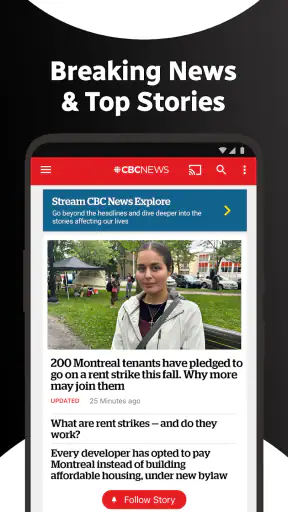
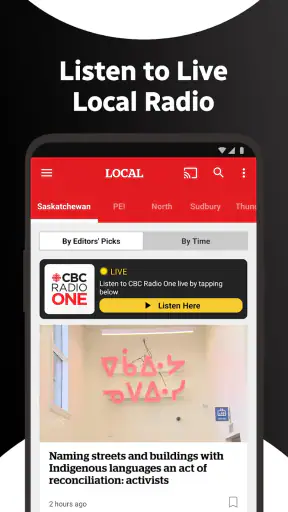


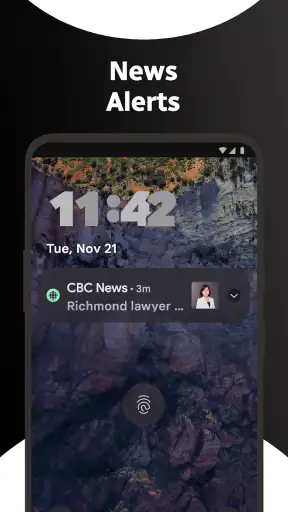
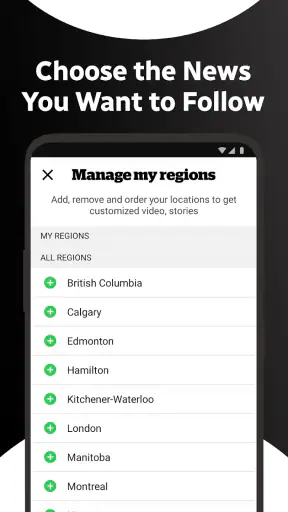


I reach for CBC News: Breaking & Local when I want a quick sense of what is happening in Canada without opening several different news sites. It is a free news and magazines app from the Canadian Broadcasting Corporation, and its focus is broad enough to cover national stories, international developments, and sports in one place. My overall impression is that it works best as a dependable daily briefing rather than as a complete replacement for every source I read.
The app has been around since February 19, 2011, which gives it a more established feel than many newer news products. It currently carries a 4.6 average from around 87 thousand ratings, with more than a million installs. Those figures suggest that it has become a familiar choice for readers who want CBC journalism on a phone, but popularity alone does not make every reading session equally smooth. The quality of the experience depends heavily on your connection, your patience with loading, and how deeply you want to follow a story.
How CBC News fits into a connected daily routine
When a live connection makes the biggest difference
The most useful moments are the ones when I want current information rather than a saved reading list. A commute delay, a developing political story, a major weather event, or a game result can make a news app feel more practical than a traditional website. CBC’s national and world coverage gives me a single starting point, while the local angle is valuable when the story affects my province, city, or nearby communities.
That convenience comes with an obvious trade-off: a news app is only as current as the content it can retrieve. When my connection is strong, I can move from a headline to the full article naturally. When reception is weak, the experience becomes less predictable. A headline may be enough to understand the general subject, but it is not the same as having the full context, background, and qualifications that make a news report useful.
I would not treat this as a tool for guaranteed access in a tunnel, on an airplane, or in an area with unreliable service. The sensible habit is to open it before leaving a reliable connection and give important stories time to load. I also avoid assuming that a headline I saw earlier will remain current after a long period without refreshing. That is especially important during rapidly changing events, where the first version of a report may be followed by corrections or additional context.
A realistic morning use case
My most common routine is a short check in the morning. I scan the main headlines, open one or two stories that affect my day, and then look at sports only if there is a result or event I genuinely want to follow. This is more efficient than scrolling through a general social feed, where news is mixed with opinion, advertising, and unrelated posts.
The app is also useful when I need a Canadian framing of an international story. A global event can look very different depending on the audience, and CBC’s national perspective helps me decide whether a subject has direct relevance at home. I still compare major stories with another source when the decision matters, but CBC gives me a sensible first read instead of forcing me to search from scratch.
For a student, commuter, or office worker, the strongest workflow is selective rather than constant. I would not leave the app open all day expecting it to replace a newsroom or a live broadcast. I would use it to identify what deserves attention, read the important article, and then close it. That approach also reduces unnecessary loading and makes the app feel less demanding on a limited mobile connection.
What changes on mobile
A phone is a good fit for short news sessions because the screen encourages quick decisions. I can judge from the headline and opening text whether an article deserves several minutes. The same small screen is less comfortable for long investigations, dense background pieces, or stories that require comparing several charts and details. In those cases, I prefer a larger screen or a browser, even when I discover the article through the app.
The app’s value on mobile is therefore less about reproducing every part of a desktop news experience and more about reducing the distance between a developing story and the reader. It is convenient in a waiting room, during a lunch break, or between appointments. It is not necessarily the best environment for careful research, extensive note-taking, or reading multiple long articles in a row.
I also find that mobile context changes how critically I read. A quick headline scan can create the impression that I understand an event when I have only seen a small part of it. My practical rule is simple: if a story could affect my plans, money, safety, or opinion of a public issue, I open the complete article instead of relying on the summary view. That small extra step is one of the most important ways to use a fast news app responsibly.
When connectivity fails or becomes unreliable
The frustrating part of any connected news experience is that failure often happens at the exact moment the information feels most urgent. A crowded station, an underground platform, or a rural road can turn a quick check into repeated loading. I have learned not to keep tapping the same story indefinitely. If the article does not appear after a reasonable attempt, I move on and return when the connection is better.
That approach matters because repeated retries can make a poor network experience feel worse than it needs to be. It also prevents me from confusing a temporary connection problem with a problem in the article itself. If the main screen loads but a particular story does not, I wait and try again later rather than assuming the report has disappeared.
For important travel or event planning, I would check the relevant information before entering a low-signal area. CBC News is useful for staying informed, but I would not build a safety plan around the expectation that a live news feed will always be reachable. A radio broadcast, an official local alert, or information saved elsewhere may be more appropriate when immediate access matters.
Recovery is usually easiest when I treat the app as a source to revisit, not a screen that must solve the problem instantly. I close the failed article, return to the main feed if it is available, and try again after moving to a stronger signal. If the whole session is struggling, I stop rather than spending several minutes fighting the network. That is a small habit, but it keeps the app from taking over the moment.
Using it without wasting mobile data
News reading can quietly become data-heavy when I open many articles, refresh repeatedly, and move through several sections without a clear purpose. I use the app more carefully on mobile data by scanning first, choosing only the stories I actually intend to read, and avoiding repeated refreshes just to see whether a headline has changed.
This is particularly helpful for sports coverage, where I may be tempted to check the same developing result several times. If I only need the final score or a basic update, one deliberate check is more sensible than constant reopening. For a major event, I accept that fresh information may require a connection, but I still try to distinguish useful updates from habitual refreshing.
My best data-conscious routine is to read the most relevant national or local story first, then decide whether the world and sports sections add anything important. That order prevents the app from becoming an endless stream of articles. It also makes the service more practical for readers with modest data allowances, because attention and connectivity are both limited resources.
I would also avoid using a news app as background entertainment when I am trying to conserve data. A short, intentional visit makes sense; leaving it open while repeatedly browsing does not. If your priority is the lowest possible data use, a text-focused website or a provider’s alert service may suit you better, although those alternatives can offer less of CBC’s unified reading experience.
Where it beats familiar alternatives
Compared with checking CBC through a general web search, the app feels more direct for regular readers. I do not need to begin with a search query every time I want a national update. Compared with social media, it gives me a more focused path into reporting and removes some of the noise that surrounds shared links and personal reactions.
Compared with a newspaper app devoted to one city, CBC News has a wider Canadian and international scope. That makes it a better everyday starting point for someone who wants local relevance without losing sight of larger events. On the other hand, a strongly local publication may provide more neighborhood detail, community notices, or specialized reporting for a particular area. If your main concern is one municipality, a local source could be the better companion.
Compared with television or radio news, the app gives me more control over timing. I can read one story now and return to another later instead of following a fixed broadcast schedule. The disadvantage is that I do not receive the same passive, continuous flow of information. If you prefer listening while driving or doing chores, a broadcast or audio-focused option may fit your routine more naturally.
Compared with a dedicated sports service, CBC’s sports coverage is part of a broader news environment rather than the entire product. That is convenient for occasional sports readers like me, but serious fans who want highly specialized live tracking may prefer a service built around that single purpose. The app is strongest when sports is one part of your information diet, not the only thing you want to monitor.
Who should install it, and who should skip it
I recommend it to readers who want a free Canadian news source with national, world, and sports coverage in one mobile app. It is especially suitable if you check headlines in short sessions, value a public broadcaster’s perspective, and want local relevance without building a complicated collection of separate apps.
It is also a good fit for people who dislike the uncertainty of social feeds. The app gives me a clearer starting point for deciding what to read, and I can approach a story without first sorting through a crowded stream of comments. That does not remove the need for judgment, but it makes the first step less distracting.
I would skip it as a primary choice if you need guaranteed access during long periods without connectivity, want a highly specialized local publication, or expect an advanced sports-tracking tool. I would also look elsewhere if your ideal news experience is mainly audio, because reading on a small screen may not suit your day. In those cases, CBC can still be a secondary source, but it may not be the app you open first.
Practical details before you decide
The app is free, carries a Teen content rating, and the current version is 7.11.0. It supports devices running Android 7.0 or later. Those details make it accessible to many existing phones, although anyone using an older device should check compatibility before planning around it.
The developer is the Canadian Broadcasting Corporation, which is worth knowing because the app’s identity is closely tied to CBC’s editorial output rather than to an anonymous news aggregator. That connection is one reason I see it as a source to read deliberately, not merely a headline collection.
I would begin with a small routine instead of enabling every possible habit at once: open the app at a convenient time, read the stories that affect you, and notice how it behaves on your usual network. If loading is reliable and the coverage matches your interests, it can become a useful daily reference. If your connection is inconsistent, plan your reading around stronger service and keep another way to receive urgent information.
My verdict on the connection-dependent experience
After using it as a regular mobile news reader, I see CBC News as a strong general-purpose option with a clear Canadian center of gravity. Its best quality is not that it tries to do everything, but that it gives me a practical route from a headline to broader coverage without making me assemble the experience myself.
The main limitation is equally clear: the app is most useful when the network cooperates. That is not a reason to reject it, but it should shape how you use it. Read important stories while connected, avoid treating a headline as the whole report, and do not depend on a live news feed in places where access may disappear.
For me, the final decision comes down to reading style. If you want a free, focused way to check Canadian, world, local, and sports news during ordinary phone-based moments, I would recommend giving it a try. If you need offline certainty, deep specialist coverage, or an audio-first routine, another option may serve you better. Its real strength is dependable, selective reading when you have a working connection—not pretending that mobile news can replace every other source.


